Aikya Banerjee

D.Phil. student in Physics, University of Oxford

Portrait of Aikya Banerjee

I am a second-year D.Phil. student at the Department of Physics (Astrophysics sub-department), University of Oxford, currently working with Prof. Alex Schekochihin and Dr. Archie Bott. My studentship is funded by the Clarendon Fund Scholarship (link). My broad research interests are plasma physics, turbulence, and statistical mechanics. I am currently working on anomalous transport properties in weakly collisional plasma.

Before coming to Oxford, I did an Integrated B.S.-M.S. in Physical Sciences at the Indian Institute of Science Education and Research (IISER) Kolkata, where I primarily worked on non-equilibrium statistical mechanics and turbulence. I completed my M.S. thesis on Many Body Chaos in Fully Developed Turbulence (thesis) at the International Centre for Theoretical Sciences (ICTS), Bengaluru, under Prof. Samriddhi Sankar Ray.

Thanks for dropping by! Feel free to reach out if you have any queries.

Address
Department of Physics, University of Oxford
Denys Wilkinson Building, Keble Road
Oxford OX1 3RH, United Kingdom
Email
aikya [dot] banerjee [at] merton [dot] ox [dot] ac [dot] uk

Overview

My primary area of interest is plasma physics, turbulence and statistical mechanics. As a part of my D.Phil. studentship at Oxford, I am currently studying anomalous transport properties in weakly collisional plasma, with a particular interest in anomalous diffusion due to micro-instabilities, under the supervision of Prof. Alex Schekochihin and Dr. Archie Bott. My work combines analytical studies and numerical experiments, particularly particle-in-cell simulation.

During my undergraduate years, I worked in turbulence, statistical mechanics and magnetohydrodynamics, particularly the nature of turbulent flow and its statistics, non-equilibrium phase separation, criticality and marginality, and decaying MHD turbulence.

Research Highlight

Intermittent fluctuations determine the nature of chaos in fully developed turbulence

What determines the nature of chaos in fully developed turbulence? While mean-field theory predicts a Re0.5 scaling for the Lyapunov exponent, it turns out the actual scaling is considerably steeper, Re>0.5. Furthermore, both analytical studies and direct numerical simulations (DNS) reveal that velocity perturbations have a preferred direction of growth: along the compressional eigendirection of the stress tensor. Crucially, this steeper scaling originates from intermittent fluctuations in the eigenvalues of the stress tensor.

This work has been featured as an Editor’s Suggestion in Physical Review Letters 136, 214001. Find out more on the journal webpage.
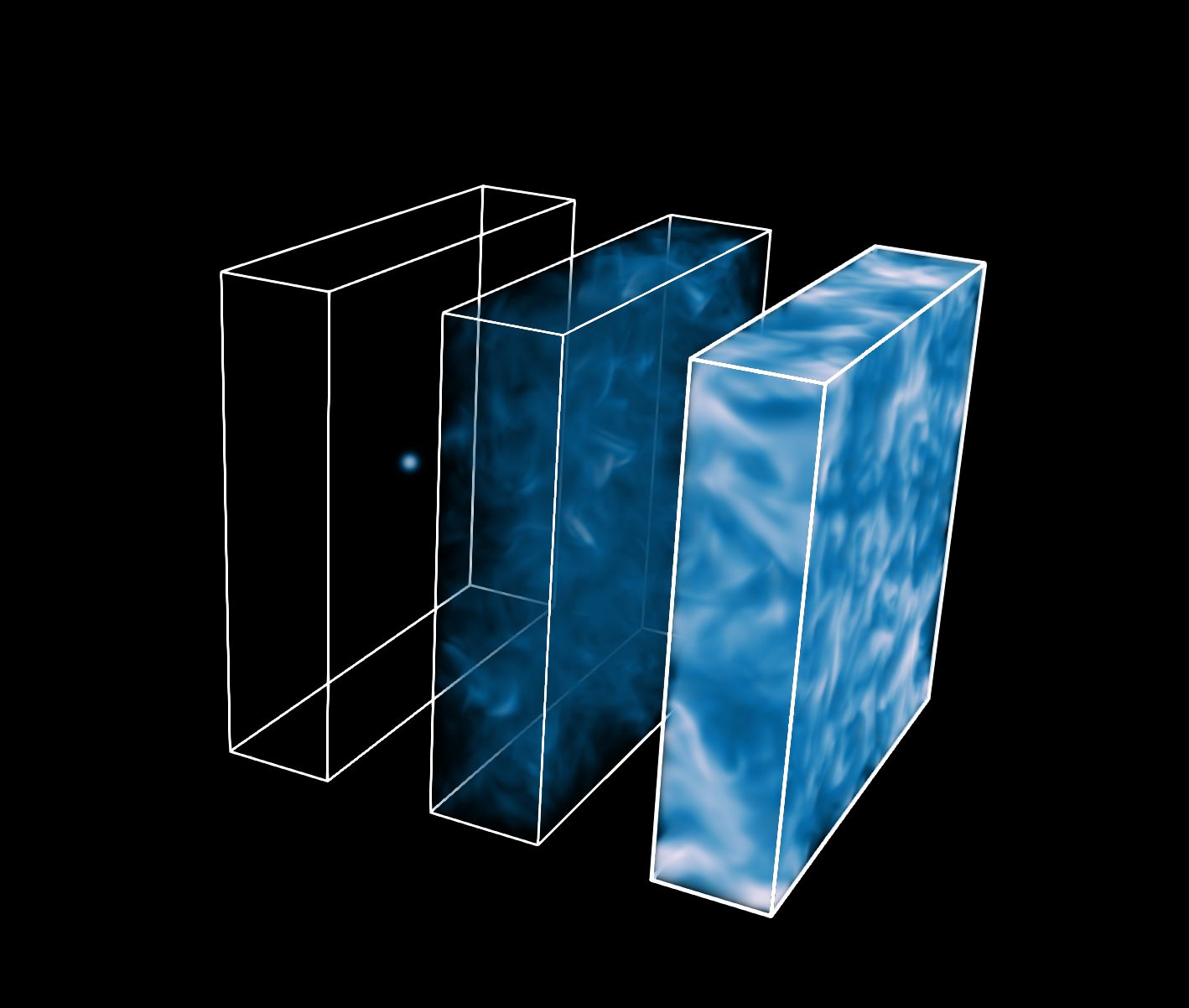

Out-of-time-order correlator (OTOC) measurements from direct numerical simulations
Figure 1. Decorrelator growth (using DNS).

Previous Research Experience

  1. M.S. Thesis, International Centre for Theoretical Sciences, Bengaluru Advisor: Prof. Samriddhi Sankar Ray. Thesis title: Many Body Chaos in Fully Developed Turbulence (thesis).
  2. Student, Indian Institute of Science Education and Research Kolkata Mentor: Prof. P. K. Mohanty.
  3. Remote Internship, Nordic Institute for Theoretical Physics (NORDITA) Mentor: Prof. Axel Brandenburg. On Relevant decay law and conserved quantities in decaying MHD turbulence.
  4. Summer Internship, Johannes Gutenberg University Mainz Mentor: Prof. Peter Virnau. Funded by the German Academic Exchange Service (DAAD) through the Working Internships in Science and Engineering (WISE) programme.

Publications

  1. Parity dependent scaling of velocity gradients in turbulence A. Dey, R. Mukherjee, A. Banerjee, S. S. Ray arXiv:2605.19921
  2. Towards a matrix product ansatz in two dimensions C. G. Ray, A. Banerjee, P. K. Mohanty arXiv:2605.20160
  3. Intermittent fluctuations determine the nature of chaos in turbulence A. Banerjee*, R. Mukherjee*, S. D. Murugan, S. Bhattacharjee, S. S. Ray (* contributed equally) Physical Review Letters 136, 214001
  4. Turbulent magnetic decay controlled by two conserved quantities A. Brandenburg, A. Banerjee Journal of Plasma Physics 91 (1), E5 (2025)
  5. Geometric percolation in the Ashkin–Teller model A. Banerjee, P. Jana, P. K. Mohanty Physical Review B 111 (1), 014403 (2025)
  6. Site-percolation transition of run-and-tumble particles S. K. Saha, A. Banerjee, P. K. Mohanty Soft Matter 20 (47), 9503–9509 (2024)

Upcoming Course

I am teaching Condensed Matter (B6) for third-year undergraduate students at Merton College, University of Oxford, in 2026–27.

To find out more details about the tutorials, click here.

I am also serving as a teaching assistant for the Astrophysics C1 course this year.

Previous Teaching Experience

  1. Graduate Teaching Assistant, Merton College, University of Oxford Statistical Physics and Thermodynamics (PH2202), for second-year undergraduates. Course instructor: Prof. Alex Schekochihin.
  2. Teaching Assistant, IISER Kolkata Thermal Physics (PH2202), for second-year undergraduates. Course instructor: Prof. Koushik Dutta.
  3. Teaching Assistant, IISER Kolkata Mechanics I (PH1101), for first-year undergraduates. Course instructor: Prof. Golam Mortuza Hossain.